Trading Orange County for San Francisco is a big lifestyle switch.
You go from wide streets, attached garages and free parking in Irvine,
Tustin or Mission Viejo to steep hills, walk-up flats and curb space
that has to be reserved days ahead. This guide covers what’s different
about this move, from the drive up I-5 to your first night in the city,
so you can plan it with fewer surprises.
How Far Is San
Francisco from Orange County?
Most OC moves to San Francisco run about 410 to 425
miles, depending on where you start. Based on OpenStreetMap
routing (OSRM), the fastest truck-friendly route is roughly:
- Anaheim to San Francisco: about 408 miles
- Santa Ana to San Francisco: about 414 miles
- Huntington Beach to San Francisco: about 418
miles - Irvine to San Francisco: about 420 miles
- Newport Beach to San Francisco: about 425
miles
On a good day that’s around 7 hours behind the wheel of a car. A
loaded moving truck is slower, and you’ll want stops, so plan on a full
day on the road.
I-5 or US-101?
There are two ways north, and both start by getting through Los
Angeles County.
- I-5 through the Central Valley is the standard
route. You take the 405 or the 5 north through LA, climb the Grapevine
over Tejon Pass, then run straight up the valley before cutting west on
I-580 toward the Bay Bridge. It’s the shortest and most predictable
option for a moving truck. - US-101 along the coast goes through Ventura, Santa
Barbara and San Luis Obispo. It’s prettier, but OSRM puts Irvine to San
Francisco this way at about 461 miles and more than an hour longer, with
more towns and traffic lights along the way. It’s a nice drive in your
own car, but it’s not the best choice for a truck.
Either way, the slowest part is often the first hour. Leaving Orange
County before the morning rush and getting through LA early makes a big
difference. In winter, check Caltrans road conditions before you go,
because snow and ice can close the Grapevine.
Cost of Living:
Orange County vs. San Francisco
People often expect San Francisco to be far more expensive than
anywhere in OC. The real picture depends on which OC city you’re leaving
and how much space you need. Here’s what Zillow’s rental data showed as
of November 8, 2026:
| City | Average rent, all rentals | Average 1-bedroom | Average studio |
|---|---|---|---|
| San Francisco | $4,833 | $4,311 | $2,928 |
| Irvine | $4,800 | $2,914 | $2,716 |
| Anaheim | $2,463 | $2,050 | $1,995 |
Source: Zillow Rental Manager market trends for San Francisco,
Irvine and Anaheim, updated November 8, 2026.
A few takeaways:
- Overall averages for Irvine and SF are close, but
that’s partly because Irvine has many larger homes and townhomes for
rent. A one-bedroom costs about $1,400 more a month in
SF than in Irvine. - Coming from north OC is a bigger jump. An Anaheim
renter could pay roughly double for a one-bedroom in San Francisco. - SF rents have been climbing fast. Zillow shows San
Francisco’s average rent up $1,233 from a year earlier, while Irvine’s
dipped slightly. Lock in a lease before you schedule the truck.
Parking is the other big change. A garage or monthly spot in the city
can be a real extra cost, so ask about it before you sign a lease.
From
Suburban OC to Dense SF: What Changes on Moving Day
This is where an OC-to-SF move is really different from a typical
move within Southern California.
You need a permit to park
the truck
In most of Orange County, the truck just pulls up to the driveway. In
San Francisco, you’ll usually need to reserve curb space with
Temporary Tow-Away No Stopping signs from the SFMTA.
Here’s what the SFMTA’s temporary signage page says:
- Apply through the SFMTA online portal or by calling 311, at least
5 business days before move day. Legal holidays don’t
count. - Signs must go up at least 72 hours ahead on
unmetered streets and 24 hours ahead at metered
spaces. - Moving reservations can run from 7 a.m. to 10 p.m.
only. - For permits of up to 3 days through the portal or 311, the posting
fee starts at $355 for 1 to 4 signs (effective July 1, 2026). Metered spaces add $21 per meter per day.
If you plan to use a portable storage container or a moving POD on
the street, that’s a separate permit from San Francisco Public
Works, not the SFMTA.
Hills, stairs and tight
buildings
Plenty of SF homes are Victorians and Edwardians with front steps,
narrow hallways and no elevator. Newer buildings often have freight
elevators that you have to book, along with a certificate of insurance
from your mover. Before move day, ask your building manager:
- Is there an elevator, and does it need to be reserved?
- Are there set move-in hours?
- Does the building need a certificate of insurance?
- How far is the nearest legal spot for a large truck?
On steep or narrow blocks, crews may need to carry items farther, so
sort that out during the estimate.
Less space than you’re used
to
A three-bedroom house in Lake Forest or Huntington Beach rarely fits
into a typical SF apartment. Sell, donate or store the extra furniture
before you go, because it’s cheaper than moving 400+ miles of things
that won’t fit. Measure your new place, especially doorways and
stairwells, before you decide what makes the trip. Big sectionals and
king-size bed frames are the usual problems.
Storage bridges the gap
Many OC families move the essentials first and keep the rest in
storage until they know the new space. Short-term storage also helps
when lease dates don’t line up.
Timing Your Move
- Avoid the first and last days of the month if you
can. That’s when SF buildings, elevators and curb space are most in
demand. - Mid-week moves usually mean easier freeway traffic
out of OC and less competition for parking in the city. - Give yourself lead time. Leave room for the SFMTA’s
5-business-day processing and for building approvals. - Pack for SF weather. Keep a jacket handy on moving
day. San Francisco summers are often cool and foggy, which surprises a
lot of people coming from the OC coast. - Book your movers early for late spring and summer,
the busiest moving season.
How Best Fit
Movers Handles Long-Distance OC Moves
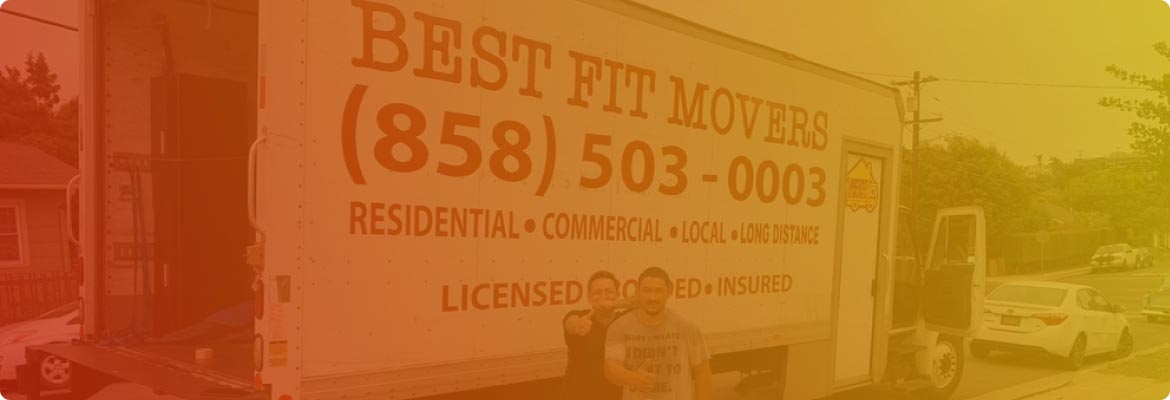
Best Fit Movers is based in Southern California, with an office in
Santa Ana, so a move from Orange County is home turf for our crews. Our
Orange County
movers handle everything from Fullerton condos to Newport Beach
homes, and our long-distance
Orange County movers take care of the full trip north.
For an OC-to-SF move, that means:
- Licensed drivers. Our professional drivers take the
truck up I-5, so you don’t have to drive an oversized vehicle 400+
miles. - Careful packing and protection. We use blankets,
padding and wardrobe boxes, and we take apart and put back together
large furniture. - Specialty items. We move pianos, artwork and
antiques, which matters when they have to go up SF stairs. - Storage options. We offer storage for the furniture
that won’t fit, or for gaps between lease dates. - Planning for the city side. We’ll talk through
truck access, building rules and parking permits before move day.
Every move is priced on its own details, like how much you’re moving,
packing needs, stairs and access at both ends, and timing. The easiest
way to know your cost is to get a free moving
quote.
FAQ: Moving from
Orange County to San Francisco
How long does it take to move from Orange County to San
Francisco? The drive is about 410 to 425 miles, roughly 7 hours
by car. With loading in OC and unloading in SF, most moves take one to
two days, depending on the size of your home and access at both
ends.
Do I need a parking permit for a moving truck in San
Francisco? Usually, yes. To reserve curb space, apply to the
SFMTA for temporary no-parking signs at least 5 business days ahead. For
a short permit, fees start at $355 for 1 to 4 signs, and metered spaces
cost extra. Storage containers need a separate permit from SF Public
Works.
Is San Francisco more expensive than Orange County?
For most renters, yes, especially for smaller units. As of November
2026, Zillow showed an average one-bedroom at about $4,311 in San
Francisco, compared with $2,914 in Irvine and $2,050 in Anaheim.
Is I-5 or the 101 better for a moving truck? I-5 is
usually the better choice. It’s shorter and more direct, and it’s easier
for a large truck. US-101 is scenic but adds about 40 miles and more
than an hour.
Ready to Plan Your Move
North?
Moving from Orange County to San Francisco takes more planning than a
move across town. You’ll need permits, measurements and a realistic idea
of how much space you’ll have. Tell us where you’re starting and where
you’re headed, and we’ll put together a plan that fits. Request your free moving
quote to get started.